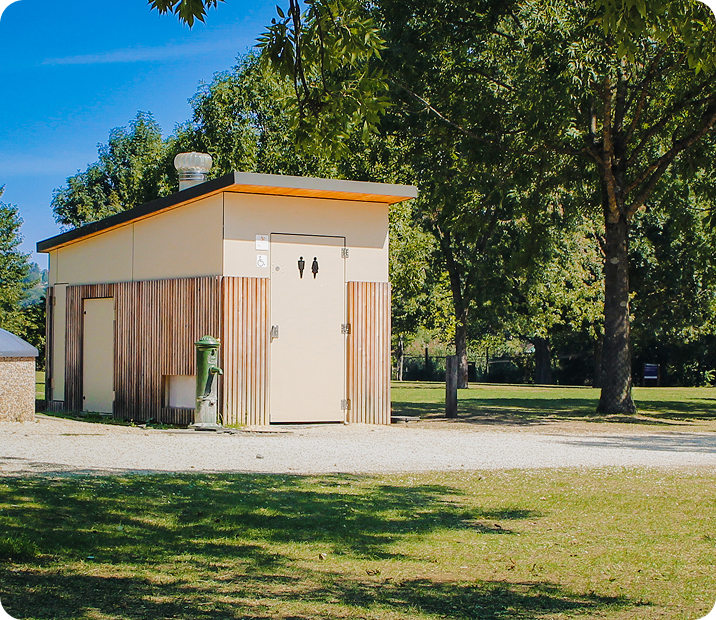
Urine, composed of 95% water and rich in nutrients (nitrogen, phosphorus, potassium), represents a natural agricultural resource. Used as a fertilizer, it advantageously replaces chemical fertilizers.
Research, such as that from the OCAPI program (École des Ponts ParisTech), shows that 1 liter of urine can help produce the equivalent of two baguettes of bread.
By enabling the local valorization of resources, Sanisphere contributes to reducing management costs while supporting more sustainable and resilient agriculture.
SANISPHERE is actively involved in the developing recycling supply chains, based on the creation of sources of separated urine from its facilities. Building on operational proofs of concept, the company assists interested local authorities in implementing regional recycling initiatives.
SANISPHERE thus serves as a facilitator, by fostering connections between local authorities that manage mineral deposits and agricultural stakeholders interested in these new resources.
SANISPHERE is part of the collective Urivalyon a regional initiative aimed at establishing a system for recycling human urine for agricultural purposes. This project brings together stakeholders from the construction, sanitation, research, and agriculture sectors, as well as local governments, to test practical solutions for collecting and recycling nutrients. The goal is to promote the return of nitrogen and phosphorus to the soil, while reducing dependence on synthetic fertilizers. This approach helps build a more sustainable and resilient agricultural system.
This approach is fully aligned with SANISPHERE’s commitment within the Ecological Sanitation Network (RAE), an association that has been working for over ten years to defend the general interest in sanitation. The RAE promotes an ecological approach based on responsible resource management, pollution reduction, and flux recycling, in close collaboration with public and private stakeholders.
SANISPHERE is also a member of theATEP, the professional syndicate for Actors in On-Site Water Treatment, where it contributes to technical, regulatory, and societal discussions related to off-grid sanitation solutions, alongside committed and recognized sector players.
At Sanisphere, we believe that every drop counts. The Ti²VALUE project aims to develop waterless toilets suitable for multi-story buildings, enabling a drastic reduction in water consumption while recovering the nutrients contained in urine and solid waste.
Thanks to innovative technologies, including self-cleaning surfaces and optimized separation and transport systems, Ti²VALUE makes everyday use easier and ensures hygiene and comfort for users.
Beyond technological innovation, the project is based on a social and collaborative approach involving academic and local partners to create local value-added supply chains and foster acceptance of these solutions.
Sanisphere helps create more resilient buildings, improves water management, and reduces environmental impact, while laying the groundwork for a circular economy based on resources derived from our daily activities.
Renewing the trees of the Grande Chartreuse monastery
A patronage commitment to forest heritage
As part of our corporate social responsibility policy, we have chosen to support a project for the preservation of the Grande Chartreuse national forest, located in the heart of the Chartreuse Regional Natural Park, in Isère.
This forest, labeled Forêt d’Exception®, is recognized for the richness of its natural, landscape, and cultural heritage. It notably houses the Grande Chartreuse monastery, a historic monument and a spiritual landmark, visited by several thousand people each year.
Due to the effects of climate change, nearly 600 heritage trees bordering the alley connecting the Correrie to the monastery are now showing signs of weakening. Many of these trees, over a century old, require careful monitoring to ensure their renewal and the sustainability of the site.
We have thus provided our support to a multi-year management program led by the National Forestry Office. This plan includes progressive and reasoned interventions: in-depth phytosanitary diagnosis, pruning operations, targeted felling when necessary, enhanced surveillance, and maintenance of trees with high ecological value.
Through this patronage, SANISPHERE reaffirms its commitment to concretely contribute to the preservation of ecosystems, the protection of natural heritage, and the transmission of living and resilient environments to future generations.
Photo credit: ONF